
Virtual Assistants Latin America Hiring Guide
Your support inbox is full again. A demo lead is waiting for a reply, three customers have fresh tickets, and the calendar still has two follow-ups that should've been confirmed yesterday. For a lot of SaaS founders, that's the moment virtual assistants Latin America starts sounding less like a hiring category and more like a way to keep the business moving without adding another layer of management chaos.
The best Latin American assistant is usually not a generic admin helper. They're often a remote operator, someone who can triage inboxes, qualify leads, update a CRM, search documentation, and keep customer work moving while your team stays focused on product and revenue. That's why the decision isn't really “hire cheap labor or don't.” It's whether the role is designed for human judgment plus AI support, with clear handoffs, trust rules, and the right country fit.
Why SaaS Teams Are Hiring Virtual Assistants in Latin America
A founder rarely wakes up thinking about labor markets. They wake up to a Slack thread, a support queue, and a sales lead that's gone cold because nobody followed up fast enough. A good Latin American assistant helps absorb that pressure by taking over the recurring work that keeps piling up around the edges of the core product team.
For SaaS operators, the value is not just admin relief. It's the chance to hand off repeatable, documented work such as inbox triage, lead qualification, customer scheduling, CRM cleanup, and content operations to someone who can work inside your hours and understand your workflows. That matters especially for smaller teams that need more operational capacity without building a large internal support department.
How SaaS companies make money is worth keeping in mind here, because assistant work should support the revenue engine, not sit beside it as a separate cost center. If a task improves response speed, keeps pipeline moving, or reduces founder context switching, it's probably a good candidate for delegation.
Practical rule: if a task can be written down, checked twice, and handed off without weakening customer trust, it's likely assistant work.
What this role looks like in practice
A Latin American virtual assistant today might do much more than calendar work. They may route support tickets, prepare meeting briefs, organize research, draft first-pass content, or keep internal documentation tidy. In a design team, that might mean collecting client assets and managing revision trackers. In a dev team, it might mean organizing bug reports, documenting edge cases, or keeping release notes consistent.
That's the shift readers often miss. The role is moving away from “someone who answers email” toward someone who keeps systems clean and moving.
The rest of the hiring process becomes easier once that's clear. The choice set becomes manageable, the onboarding plan gets simpler, and the compliance questions are easier to ask in the right order. The next step is understanding why the region is now such a strong environment for this kind of assisted work.
How AI Adoption Is Reshaping Assistant Work Across the Region

A founder hires a Latin American assistant to keep work moving, then asks a second question. Can that person also work with AI without turning every task into a risk? For many teams, that is now the hiring test.
The answer is usually yes, as long as the role is designed well. Latin America is becoming a useful place to hire assistants because many businesses there are already treating AI as part of normal operations. In a 2024 HLB survey, 32% of Latin American business leaders said they were already using AI, 30% were exploring it, and 26% said they would try AI when the right use case emerged, which means 88% were either using, evaluating, or open to adoption. The same survey found 67% expected AI to become their most important technology over the next five years, while 40% pointed to a lack of digital-transformation skills as the main barrier.
That changes the job itself. A modern assistant is less like a human inbox and more like an orchestration layer, someone who connects tools, checks outputs, and decides when the machine should stop and a person should step in. AI can speed up search, summarization, first drafts, and routine routing, but the assistant still owns the final quality.
A 2024 study cited by the IMF reported that about 80% of surveyed companies were already using AI solutions, with early adoption concentrated in finance, customer service, research and development, IT management, and marketing. That lines up with assistant work that sits close to revenue and operations. A customer support assistant can triage tickets, gather context for a response, search documentation, and prepare internal notes without pretending the system should handle every case alone.
The cleanest way to set this up is simple. Use automation for low-risk repetition, use human review for sensitive decisions, and let AI assist the assistant rather than replace the judgment layer. Scheduling, structured data entry, and basic routing are good fits for automation. Refunds, complaints, and policy exceptions still need a person.
Consumer behavior points in the same direction. Omdia's Digital Consumer Insights 2024 survey showed that 76% of respondents in Brazil and 70% in Mexico reported using ChatGPT or similar generative-AI services, compared with a 66% global average. In practice, that means AI is less likely to feel strange to workers and customers alike. It is becoming part of the workflow.
For SaaS teams, the takeaway is straightforward. Latin America is not just a place to find remote help. It is a region where assistants are increasingly expected to work as AI-literate operators with human support, which makes hiring stronger when the role includes clear guardrails, trust design, and country-specific compliance.
Benefits Tradeoffs and Time Zone Advantages to Weigh

The easiest mistake is comparing regions by price alone. That view misses the core hiring question, which is whether the assistant can stay in sync with your team, communicate clearly, and handle the mix of live and async work your process needs.
Where Latin America tends to shine
Latin America often works well because much of the region sits close enough to U.S. business hours to make live coordination feel natural. That helps when a founder needs a handoff before a customer call, a same-day update to a lead list, or support coverage while the team is still online. It also gives many teams access to a wide range of language profiles, which helps with Spanish-language customer work and, in some markets, Portuguese.
As noted above, early AI adoption concentrates in support-adjacent functions, which is why overlap for live triage matters more than back-office coverage. A customer support assistant can sort tickets, gather context for a reply, search documentation, and prepare internal notes without pretending every issue should be automated.
Where the tradeoffs show up
The tradeoffs are practical, not abstract. Infrastructure can vary by country and even by city. Payment logistics, connection reliability, and internal security habits can all create extra work if they are not handled early. A lower hourly rate stops looking low if the manager keeps rechecking work, waiting on replies, or rebuilding a process that should have been simple.
Role maturity is another filter. Some businesses still picture assistants as basic admin support. The stronger fit is usually a candidate who can work as an AI-literate operator, not just a task taker. That means screening for judgment, communication, and comfort with tools like Slack, Asana, Google Workspace, CRM systems, and AI drafting or research workflows.
Country choice matters here too. A team that needs strong English coverage for U.S. customers may look at different markets than a team focused on Spanish-speaking support or bilingual client work. A company that values same-day collaboration may prefer a location with tighter overlap, while a company that runs more asynchronously may accept less shared time and more structured handoff docs.
What this means for different teams
SaaS founders can use a Latin American assistant for inbox triage, lead qualification, and support handoffs.
Design teams can delegate asset collection, revision tracking, and client follow-up.
Developers can offload bug intake, documentation cleanup, and release coordination.
The right question is not whether Latin America is better in the abstract. The right question is whether the task benefits from nearby time zones, multilingual coverage, and a worker who can handle both human coordination and tool-based assistance. If that is the fit, the region can be a strong operational choice.
How LatHire Can Help
When the hiring process feels messy, the main pain point is usually not the lack of candidates. It's the cost of sorting, screening, and coordinating across borders while still trying to run the business. That's where a managed platform can help, especially for founders who want a more structured route to latin american virtual assistants.
LatHire is a hiring platform that connects U.S. and Canadian companies with pre-vetted Latin American professionals across technology, marketing, sales, and operations. It combines AI assessments, skills evaluations, and human-led background checks, then helps match companies with candidates quickly. For teams that don't want to build a cross-border hiring process from scratch, that can remove a lot of friction.

The most useful part of a service like this is not the marketing copy. It's the structure. A founder can bring an existing role description, get help shaping it, review candidates with validated profiles, and avoid spending days sorting through noisy resumes. That matters most when the role needs both time-zone alignment and a real check on communication quality.
For readers comparing options, latin american virtual assistants is a useful reference because it frames the hire around practical fit, not just geography. The right choice is usually a role that needs reliable coverage, good communication, and enough process discipline that a pre-vetted hire can start contributing quickly.
LatHire tends to make the most sense when the team wants managed hiring support, help with payroll or compliance, or a shorter path from job description to shortlist. It's less interesting if the company already has local hiring infrastructure and wants to run everything in-house. In other words, it's best for teams that want the cross-border complexity handled so they can focus on onboarding and output.
Where to Find and How to Vet Top Latin American Talent
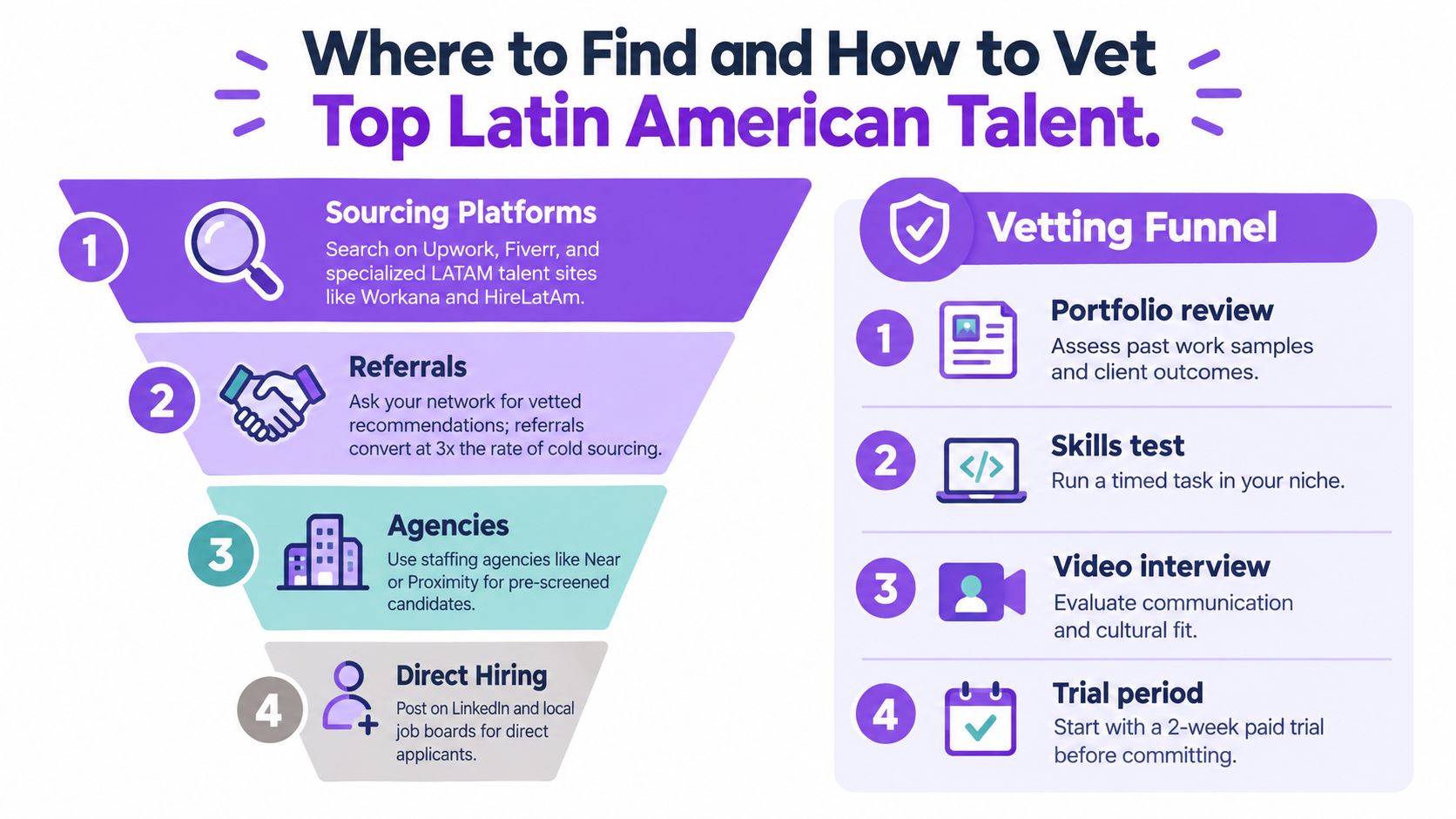
A strong search starts with a narrow brief. A job post should spell out the outcome, the tools, the working hours, and what good work looks like. “Help with operations” brings in vague replies. “Manage inbox triage, lead routing, and weekly CRM cleanup in a 9 a.m. to 1 p.m. ET overlap” gives candidates a real target.
Sourcing channels that work
Each channel solves a different hiring problem. Marketplaces give quick reach, referrals often surface trust faster, agencies can handle screening, and direct hiring gives the team more control. The best mix depends on whether the role needs temporary coverage or a longer operational fit.
Sourcing platforms: search marketplaces and regional talent sites for wide reach.
Referrals: ask trusted operators for candidates who have already been tested in real work.
Agencies: use them if screening time is the bottleneck.
Direct hiring: post the role when the team wants tighter control over selection.
The channel matters less than the filter you use.
A vetting funnel that predicts performance
Start with a portfolio or work sample review, then move to a timed task that mirrors the job. For a support role, that might mean rewriting a confused customer reply. For an ops role, it might mean cleaning up a spreadsheet or documenting a workflow. Then run a live interview to check spoken communication and problem solving under light pressure.
A short paid trial is often the clearest final step. It shows whether the candidate can follow instructions, keep response times steady, and work without constant nudging. That is more useful than a polished resume, because the work itself becomes the proof.
Useful signal: candidates who ask clarifying questions about goals, tools, and escalation paths usually adapt better than candidates who only talk about speed.
Regional demand is also moving up the skill ladder. The World Bank notes that jobs requiring AI fluency increased nearly elevenfold between 2023 and 2025 in the countries analyzed by McKinsey World Bank. That makes AI tool comfort a sensible screening criterion, not a bonus.
Red flags to watch
Vague answers about prior ownership suggest the person assisted without really operating.
Slow written responses often predict weak async work.
Overconfident English claims without live proof can waste time later.
No questions about tools or scope can mean the candidate has not thought through the job.
The aim is not a perfect hiring system. It is a shortlist of two or three people who have already shown they can do the work, communicate clearly, and operate the way your team runs.
Sample Job Description and 30 Day Onboarding Workflow

A good job description reads like a handoff note, not a wish list. It should name the outcomes, the tools, the working window, and the standard for success. If the role is meant to support a SaaS team, that usually means Slack, Asana, Google Workspace, CRM access, and a clear overlap window for live communication.
What a strong role definition includes
The first version should answer four questions plainly. What work does the assistant own, what tools do they use, when are they expected to be available, and when should they escalate? Without those answers, onboarding becomes improvisation.
A useful setup often looks like this:
Outcome: keep inbox and follow-up work moving without founder intervention.
Tools: Slack, Asana, Google Workspace, CRM, and shared documentation.
Hours: a clear overlap block that matches the business's live coverage needs.
Success measures: response speed, completion accuracy, and clean handoffs.
The role becomes easier to manage when the assistant gets a cockpit, not a pile of scattered tasks. That means written SOPs, Loom walkthroughs, and a defined path for escalation.
How the first month should unfold
Week one should be mostly orientation. Access, team context, documentation, and standards come first. Week two should move into shadowing, where the assistant watches how work is handled before taking on small supervised tasks. Week three can shift to independent work with check-ins. Week four should be a review of what was learned, what still needs clarification, and which workflows can now be owned directly.
A production-quality onboarding process also needs to acknowledge that operational assistants in the region are increasingly working alongside AI tools. The World Economic Forum's regional evidence notes that about 15% of organizations report deploying AI chatbots, real-time agent support, or call-transcript analysis at scale WEF. That makes it even more important to define where automation ends and human judgment begins.
A simple way to think about the first 30 days
Week 1: learn the system.
Week 2: observe and copy.
Week 3: handle real work with supervision.
Week 4: own a narrow workflow and report on it.
If the assistant cannot explain the workflow back in their own words by the end of the month, the job is still too fuzzy. Good onboarding reduces confusion, creates consistency, and gives the founder a real sense of whether the role was scoped correctly.
Compliant Contracts Payroll and Country Selection Basics
Cross-border hiring gets messy when legal and operational details are treated like an afterthought. The cleaner path is to separate three questions at the start: who employs the person, who pays them, and who owns access, privacy, and offboarding.
Contractor, employer of record, and direct employment are different setups, not interchangeable labels. Each one creates different obligations, and those obligations change by country. A founder does not need to become a lawyer, but they do need a process that answers basic questions before someone handles customer data or internal systems.
What to compare before choosing a country
Latin America is not one labor market. Countries differ on language, payment reliability, internet infrastructure, and local hiring norms. A country that works well for one role can be a poor fit for another, even if the hourly rate looks attractive on paper.
A practical country checklist includes:
Language fit: Spanish, Portuguese, or English, depending on the role.
Time-zone fit: whether the person can cover live hours without an exhausting schedule.
Infrastructure risk: how stable connectivity and payment setup are likely to be.
AI readiness: whether the role calls for someone who already works comfortably with AI tools.
Where backup connectivity and equipment budgets are needed, scope them by city-level infrastructure checks during vetting rather than by national averages. That keeps the decision tied to the actual working environment, not a broad assumption.
What good operational hygiene looks like
Sensitive access should be limited. Shared passwords should be avoided. The assistant should only get the permissions needed for the role, and those permissions should be reviewed as the role changes. If the person handles customer records, invoices, or internal docs, the handoff should be documented from the start.
A low hourly rate can hide higher management costs if the team has to rebuild the process, chase missing updates, or fix avoidable security mistakes.
A simple analogy helps here. Hiring across borders is like setting up a new service account, you do not hand over every key on day one. You give access in layers, then widen it only when the workflow proves stable.
The cleanest way to avoid problems is to choose the right country for the role, then choose the right employment model for the legal and payment setup. The more complex the function, the more valuable it is to keep contracts, payroll, and offboarding structured from day one.
Best Practices for Managing High Performing Assistants Long Term
The strongest assistant relationships don't come from one good hire. They come from a repeatable operating rhythm. That rhythm needs clear task ownership, a practical review cadence, and a simple rule for when AI helps and when a human must step in.
The best long-term setup is risk-tiered delegation. Low-risk tasks can be automated or templated. High-risk or emotionally loaded issues should route to a human quickly. That's especially important in support, billing, and account recovery, where a wrong answer can create more work than the original ticket.
Regional consumer behavior makes that distinction even more important. Research cited in the region shows that 64% of Latino consumers are willing to delegate customer-service tasks to AI assistants, while 78% say friendliness matters to a positive AI-agent experience. The same research also says 85% would rather speak with a human by phone than interact with a machine, and fewer than 30% trust AI with emotionally charged or high-stakes issues TI Inside.
That means a strong manager doesn't force automation everywhere. They design a handoff rule. Shipment tracking, password guidance, and appointment scheduling can be handled by the assistant or automation. Complaints, billing disputes, and account-sensitive issues should move to human review fast.
A simple long-term operating rhythm
Weekly check-ins: review priorities, blockers, and handoffs.
Transcript review: spot where the assistant needs clearer prompts or better escalation rules.
Metric review: look at resolution quality, not just volume.
Process updates: turn repeated questions into better SOPs.
The goal is trust with guardrails. A good assistant should feel confident enough to move work forward, but never forced to guess on sensitive issues. That balance keeps the role useful as the business grows and keeps the team from treating AI as a shortcut where judgment is needed.
If Templyo is part of the stack, this is a good moment to use it to publish the role page, onboarding docs, or hiring workflow in a clean format that your team can follow. For a SaaS founder or designer who wants a clearer hiring system, the next move is to write the role, define the risk tiers, and start reviewing candidates against a real workflow instead of a vague job title.


